
Just Believe
“For many years I dreaded the moment that the magical world of Santa Claus would come crashing down. I wanted to hold onto this little slice of magic for as long as possible, because in my mind, the fun of Christmas would diminish without full-blown believers. But as the years wore on, I found myself gradually more and more ready for my two boys to awaken to the reality of Christmas morning. As they got older and more savvy, the façade became harder to hold steady.”
“Are you guys Santa?” my youngest son wanted to know over the breakfast counter the other day. He is nine.
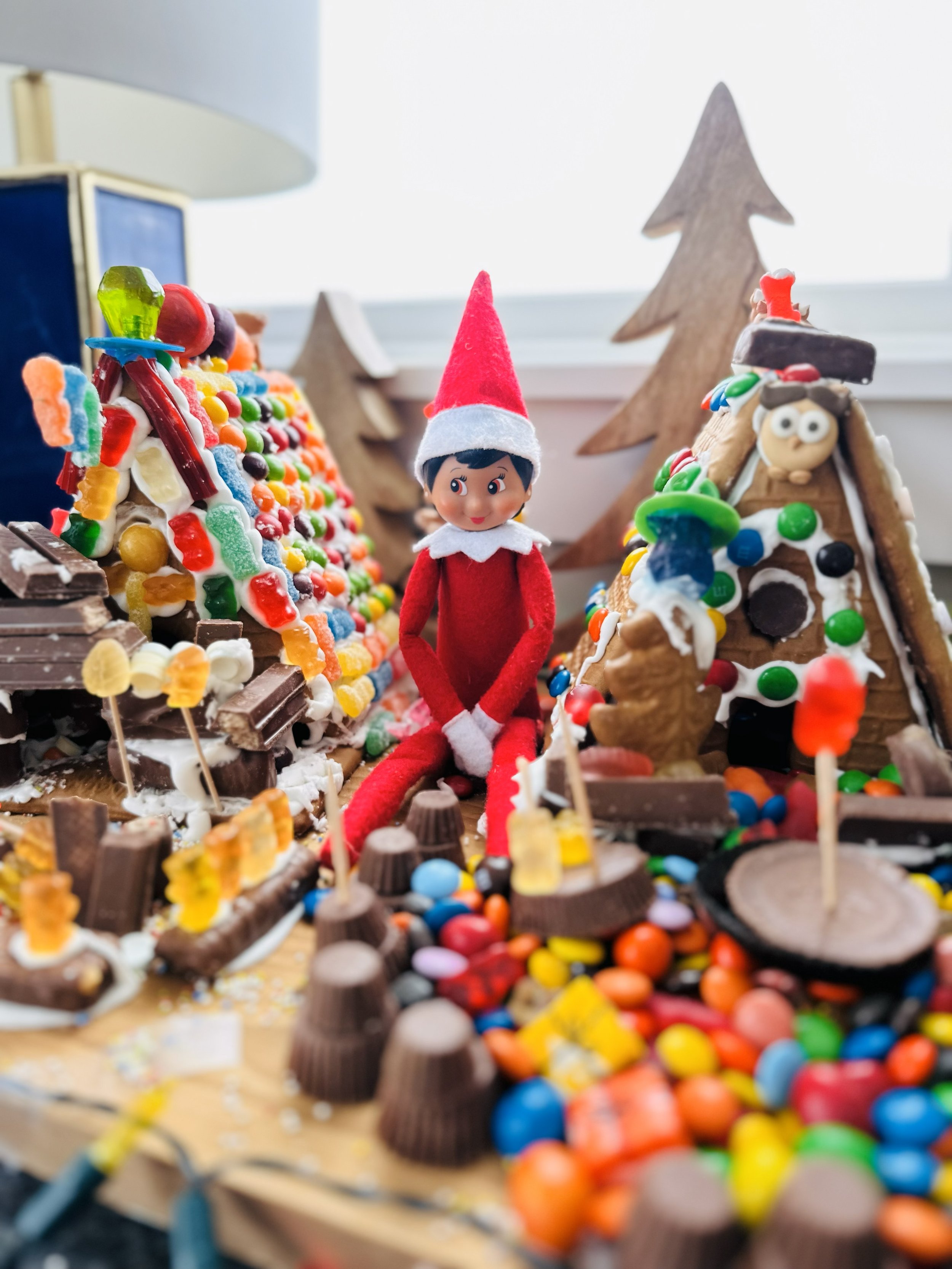
He had come downstairs that morning on a mission to find our Elf on the Shelf, Bell, who was supposed to make her seasonal debut now that our Christmas tree was up- a justification I had invented as to when she shows up at our house each year in order to bide myself some more time. As he scanned the Christmas explosion that had become my living room, his hopeful eyes darted from the bookshelf to the Balsam Fir tree to the potted plants to the dog toy basket and I could see his wide eyes narrow. That was quick, I thought. His spidey senses were up. How could he know?
“Have your smoothie,” my husband said trying to distract him, as I slipped into my bedroom to grab Bell from my sock drawer, her year-long hiding place.
“See, she’s not here!” he said angrily as he abandoned his search and slumped into his chair with a scowl. This seemed to be a confirmation not a curiosity.
As his back was turned, I quickly slipped the stiff, red-felted creature out of my robe pocket and onto a shelf he hadn’t yet looked at.
“I don’t know that you looked very hard this morning, buddy,” I said casually. “Maybe have another look.”
His Christmas Spirit meter was hovering dangerously low. Even if he found her now, I could tell it wasn’t likely to bring back his typical cheery demeanor. He slid off his chair and toward the shelf I had just placed her on.
I watched as his eyes landed on her, seated slightly off-kilter in my haste, against a few oversized hard cover books.
“There she is,” he said in a monotone voice pointing with a limp finger, as he hung his head and moved slowly back to his chair at the counter.
I kept my attention on him, my senses locked on his, as I whisked about the kitchen trying de-escalate the precarious situation with normalcy. But he felt like a ticking time bomb.
“Do you guys also move Bell every night?” he glowered at us.
For many years I dreaded the moment that the magical world of Santa Claus would come crashing down. I wanted to hold onto this little slice of magic for as long as possible, because in my mind, the fun of Christmas would diminish without full-blown believers. But as the years wore on, I found myself gradually more and more ready for my two boys to awaken to the reality of Christmas morning. As they got older and more savvy, the façade became harder to hold steady. Instead of simply enjoying the magic with kids, the stress of keeping such a big secret hidden from them became increasingly burdensome.
I worried about using the right wrapping paper (one for Santa’s gifts, one for parent’s gifts). I agonized over their presents and tried to come up with things they would be ecstatic over- nothing ever evoked the reaction I thought it would- even the adorable baby hamsters I got them one year. There were never enough closets to make sure everything was properly hidden and undetectable- every year I inevitably put presents somewhere and forgot about them- a faux-pas I had made fun of my mom for many a time. I always mis-spoke about Santa saying “I” instead of “Santa,” when discussing presents my boys had received and drawing instant corrections from them. And just generally being the sole creator of all the magic became harder and harder as the expectations mounted year after year. Nine years in, I could feel myself starting to wish my youngest son would catch on sooner rather than later.
This wasn’t the first time our youngest had asked questions about Santa or the tooth fairy or the Easter Bunny or the pull-up fairy (one I invented to coax him out of night diapers!). But no matter how many times your kids ask you the hard questions, it still feels impossible to know how or when to deliver the deadly blow to their belief in these magical beings, but most importantly Santa. Because he is the big kahuna, the one that often remains even when the rest have come unraveled. Are they asking because they actually want to know the truth or because they’re hoping you will eradicate their fears that this could all be a farse?
But on this particular morning, my husband and I both instinctively felt it was time to answer him with a more “realistic” approach. Without flat out saying “Santa’s not real,” we skirted around the exact words by saying things like, “now you get to be in on the secret and help create the magic for all the younger kids you know, like your cousin.” And “the real magic of Christmas is in so much more than just Santa and the elves.” Yet as I spoke, I began to wonder why the magic of Christmas was such a tricky subject. For both my kids, it never felt quite right to completely squash it, even when they were flat out asking me ‘what’s real here, mom?’ So why did we want our kids to believe in the magic of Christmas? Why was it so hard to simply tell them the truth?
I don’t recall this moment in my childhood. My discovery of the truth about Santa came little by little, without any bubble bursting conversation. I remember noticing that my mom’s handwriting was improbably similar to Santa Claus’s. And from there I slowly came to my own understanding of how Christmas morning arrived- not by reindeer, elves, or a big red sack. But instead by UPS, TJ Maxx, and endless hours of wrapping by both my parents.
Yet, knowing the truth of Christmas didn’t diminish my excitement for the holiday. In fact, the older I got the more I leaned into the holidays and all the traditions that my parents had long-ago established- eggs benedict on Christmas morning, my grandmother’s traditional Finnish sweet bread, hot mugs of my grandfather’s Wassel, decorating the tree with all my favorite ornaments, cozy nights with my family around the tree with the fireplace ablaze. These were the things that people usually talked about when they referred to the ‘magic’ of Christmas. Or maybe the word more widely used is ‘spirit.’ Either way, it’s a desire to perpetuate that inexplicable feeling that comes with those warm childhood memories.
Still, the question nagged at me. We could have all that kind of spirit without telling our kids a big fat lie about Santa delivering presents to every good girl and boy. What was the purpose of the magical tale of Santa and the reindeer?
I still remember the year Santa left sleigh tracks in the snow of our lawn and stomped his soot covered boots around the white living room carpet. Santa had been there for sure! Or the time I had never felt so excited when someone said they saw Santa’s sleigh flying out the window and I had plastered my little face against that glass longing to catch a glimpse of him too. Those memories are crystalized in my mind, etched with unparalleled excitement and wonder. Maybe that’s why we do it, to allow our kids to experience those rare, yet extraordinary feelings.
My dad was an adamant believer in believing. Every year at Christmas time he reminds me, again and again, “You just gotta believe, Linds!” - one of the many phrases my father has trademarked with his whimsical sentiment. I have always agreed with him, responding with “I know, Dad, I know.” But maybe I was not fully appreciating what he was trying to say. Because I hadn’t yet decided for myself why it was so important to ‘just believe.’
As my husband and I unloaded the dishwasher, stumbling over our best attempt at gentle yet honest words, my son sat staring at us over his untouched smoothie, the scowl growing deeper with every attempt. He was not buying into our exciting new way of seeing Santa Claus. Clearly we had not been as convincing (or enticing) as we’d have liked to have been. And then I heard my dad’s words echo in my mind.
“Hey bud…” I paused to let him look at me, hopeful that this might ease his contorting mind, as it had his brother’s the year before. “You just gotta believe.”
But he was too far gone by that point. His hard scowl crumpled into a surrendered wail. The outer shell of anger had finally cracked, revealing the truer, more honest feelings of sadness and betrayal that he was harboring underneath. As the tears streaked down his cheeks, he ran to bury his head in the couch cushions.
As I helplessly watched him sob into the throw pillows, it occurred to me, obviously a touch too late, that though he may have been asking the questions, he didn’t really want the answers. He was not seeking the truth. He wanted the magic. And no matter how many times I tried to console him with, “you just gotta believe,” in that moment the magic was gone, buried beneath this new reality of “now you’re’ in on the secret” that he wanted no part of.
My husband and I looked at each other with sadness at our mis-step. Now what?
Later that night, after a day at school and some distance from the difficult moment over the breakfast counter, my son’s cheer-o-meter had rebounded to normal levels. I had bought our new puppy her own stocking, with a little paw-print on the cuff, and he was happily finding a place for it to hang on the mantle among the other four.
“What do you think Santa will put in her stocking?” he pondered.
Clearly the morning conversation had fallen away like a melting iceberg. In its place seemed to be the firm decision to believe in all the magic, which certainly eased my heartache after the emotional morning we’d had. Yet I still hadn’t answered my own questions around the whole issue. Why do we want to believe in the magic? Why perpetuate this fantastical lie that we all know will eventually come crashing down and has the potential to hurt our kids?
After that morning’s events, I was starting to understand why some parents simply don’t partake in the idea of Santa and never create the façade to begin with- create the traditions and the ‘spirit’ without the lie. Yet I knew that wasn’t the answer. Because there was something to this idea of believing. Not to mention that so many other smart, capable, and well-meaning parents, over many decades, had also been willing participants in continuing this magical façade. And centuries of other fictional tales had been told to children, if not the modern-day version of Santa, but why?
The next morning, I brought my A-game and found a tricky hiding place for Bell. I was not about to have a repeat of the disaster from the day before. But I was curious to see if my son would care now that he ‘knew the truth.’
I heard his footsteps descending the stairs and watched as he rounded the corner to the kitchen. I could already see his gaze fixed on the living room, scanning the shelves for that pointy red elf hat. He hadn’t missed a beat. He knew Bell had moved and he was determined to find her. Once again, the truth had not deterred him from believing.
Later that day, I went to Target to pick up the biggest surprise gift I was planning for the boys- a Nintendo Switch 2. I knew this would shock and surprise them because my husband and I had squashed the idea many times, yet they really wanted it! I set it on the kitchen counter, planning to bring it downstairs at some point to my top-secret gift hiding closet. I put away the groceries and sat down at my computer to write.
A few hours later I heard the front door open and the groan of the bus pulling away.
“Hi bud,” I said without looking up from my computer screen.
“Hi!” he said back, cheerily. I could hear him drop his backpack like a heavy sack of potatoes, then his footsteps rounding the corner into the kitchen. I looked up to greet him and I could see his gaze lock onto the red and turquoise box sitting on the counter.
“Mommy…” he said expectantly. “What’s this?” as a smile spread wide across his face.
I smiled, trying to decide how to handle this blunder of mine. How had I forgotten to bring it downstairs?
“Damn!” I said, walking toward him to give him a hug. “You weren’t supposed to see that!”
His eyes were wide with excitement.
“Can you keep it a secret from your brother?” I asked with a smile.
“YES!” he said, starting to bounce now.
“Good!” I said, feeling his little wiry body against mine. “Because that was going to be my big surprise to you and your brother, and now you saw it!”
“I won't tell him,” he said with sincerity, wriggling free from my arms and diving gleefully onto the couch.
“I can’t believe I left that out!” I chided myself.
“It’s ok, Mommy,” he said, as a huge smile spread across his face and he jumped from the backside of the couch into my arms. “This is still the BEST present ever!”
And it occurred to me in that moment that maybe I had it all wrong. I thought my boys needed to feel the magic through the surprises and the things that were ‘unbelievable’. That if he saw how the sausage was made, he wouldn’t find it exciting anymore. I thought I had pulled back the curtain, shown him how the magic trick was done, and by doing so, taken away his ability to believe that magic had actually occurred. Yet that’s not what had happened at all. I was not the one who was breaking down the façade of magic here. In fact, seeing that Nintendo on the table not only confirmed what we had just told him two days before, but it was also the complete antithesis of it. Because now he saw it all, and still chose to believe.
Maybe the real magic of the season is not in the traditions we manage to make happen year after year, or how hopeful we can feel with the excitement of Christmas morning, or how good we are at creating magical moments for our kids, or even how joyous it is to simply be brought together with those that we love in the season of giving. Though I would argue those things are also pretty damn magical.
But maybe the real magic of Christmas is allowing our kids to show us how to believe in the magic that exists all around, to believe in the unseen, even when everyone is telling us it doesn’t exist. Maybe the real magic of Christmas is learning to believe in the possibility of inexplicable miracles and wildly improbable twists of fate. Like the serendipitous meet-up with a long-lost friend, the realizing you knew something was going to happen before it actually happened, the seeing of an implausible sign from a loved-one in spirit and knowing it was them, the trusting of that still-small voice inside you that says it’s time to move on, or the witnessing of how life finds a way to work out, seemingly magically, if we let it.
Maybe the real magic of Christmas is knowing that Santa may not be delivering presents all over the world in one night, but that something else equally as unbelievable, I would argue magical, could happen. What if the reason we want our kids to believe in Santa Claus is because we need a place to start, a jumping off point from which all other possibilities and improbabilities can flow.
Maybe the real magic of Christmas is no longer wondering if magic exists, but knowing it does.
You just gotta believe!Love,Lindsay